
The Middle ages was a time of severe punishment and harsh torture for crimes that today would seem trivial. People were beheaded and limbs cut off, vagabonds were often whipped and chained in stocks.
People lived in a state of fear thinking they would be the next victim.
Even the Catholic Church used torture and imprisonment to obtain confessions from people regardless of whether they were guilty.
Torture and punishment has existed for thousands of years. Roman and Greek law stated that only slaves were allowed to be tortured, eventually the laws changed and free men were tortured and imprisoned for committing crimes.
People often had their right hand cut of for stealing, people were beaten, burned alive, stretched on a rack and women committing adultery were drowned.
Suffocating people in water was a common practice. People were boiled in oil, eyes were burned out with pinchers and fingers torn off. Mutilation and branding’s were commonplace.
During Tudor times English laws was practically geared toward torture. Vagrancy was considered a crime and people were put in stocks so towns people could beat them.
It was the poorer classes that were discriminated against. Lords and high officials were exempt. Courts and judges did exist, but were bias and often judgements were known before the case was even heard, if a person did not turn up to court they were considered an outlaw and their property was seized and became the kings.
Outlaws banded together roaming the countryside and committing crime the most famous of these is of cause Robin Hood.
The harsher the crime the more horrendous the punishment, If a man committed Rape, Manslaughter or Robbery they would be hung up in a cage so people could see their slow death.
On some occasions they were taken down just before their death and quartered (cut into four pieces) so that the pain would kill them, a most cruel way to die. Public displays of torture were common.
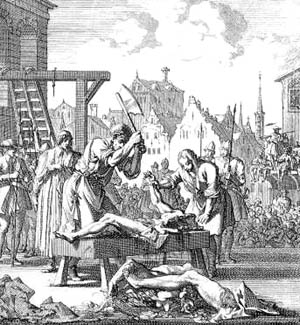
Hangings and Public torture would be announced by the kings men, people would come from far and wide often bring children with them, this was encouraged by rulers thinking it was a deterrent from committing crime, bringing fear to the townspeople.
Medieval townspeople had a very close understanding of how punishment happened, as they were often present during punishment.
Although murderers were often executed, the majority of lesser medieval offences were punished by shaming the criminal publicly.
By today’s standards people may think this was harsh however crime was not as widespread as in today’s society.
People also took pity on those in jail and prisoners were often let out to beg for food. Medieval officials lacked the resources or money to build suitable jails and people often died from illness before there trial.
In today’s society we do not use torture as a means of punishment, as history progressed torture became less prolific, it was only 100 years or so ago that this was considered a barbaric practice.
In many modern countries the killing of murders and rapists is not permitted.
In some cultures the practice of cutting off limbs for stealing is still condoned although not widely practised, people are still executed in some societies.
Does not have the information required for: When did they start torturing people in medival ages?
true
when dd the start torturing peolple in middle ages
😐
I have know idea im very sorry Regina (Lisa) lol!
I am very sorry i do not know anything about this i am having the same problem! i am very soory Regina (Lisa) lol!
They don’t really know when it started but the middle ages is considered to have started around the 5th Century, so you could assume this is when torture started in the middle ages as such.
thanks needed this info just needs when it started
This is some really cool info bro….. yeehaarrr!!
Wow, This is some really truly ad seriously sick wording mates! Helped me out so much, I just want a chance to thankyou so much for going to the time of putting this together. Its really appreciated and is helping so many our educations. You’re so sweet, 🙂 xx
:-* 🙁 😡 🙂 😡 😡 😡 😡 😡 😡 😥 😥 😮 😕 😆 😮 😳 :-* 😛 😆 😆 🙂 😉 8)
😆
awsome
no duh we do not torture people today! 😮
this is some epic stuff
:-* thankyou for my free written essay i can now use for sose (: cheers !
History esay complete thanks to this website!!!! 😆 😀
ewwwwwwwwwwwwwwww just watching i think im going to be sick 😡 😡 😡
GREAT INFO!!!! 🙂 😆 finished my sose assignment needs more on todays crime and punishment tho
great help just helped me complete my SOSE assignment 🙂
is this also refferering to medieval europe ?
helped me with my homework. Thank you!
looks good, this really helped me with my sose assingment:) its kinda disturbing but yeah:) gald i wasnt born back then! thanks heaps!:)
whoa kinda creepy
that is gross.
Could include the crimes with the punishments 😆
I really liked the article and the Youtube video which had a criminal being executed in multiple ways! However, you should have written more information about beheading individuals in the medieval period. I would really like it if you wrote an article on this website that is all about decapitating individuals during the Middle Ages, Tim Nash.
Cutting off limbs for stealings a bit harsh but i wish they still hung rapists and murderers in cages til death today. The world would be a much nicer place.
what’s SOSE??? I have to complete a history essay but not called an SOSE… plz what is it?
thats tense why did they torture people its completely in humane 🙁
this really scary
ummm ew..
yeah bad
thnx a lot!
xoxo
ewwww you duh grooss!
y did tey trture peeeps like that its horrible!!!!!!!!!!!!1 they should atleast give em one more chance nd wat if it was u!!!!!!1 people these dayz
😡
still stuck on my assignment 😥
Heyy,
I have a sose Assignment could someone please tell me When Torture in medieval Europe started and finished. I have been looking at like a million websites but i have never seen a rough time period of when it started to when it finished!!!! Please help 😥 it’s driving me NUTS 😮
Could someone tell meh when medieval Europe Torture started and finished rough dates are fine please let me know by Monday 14/5/12 Please!!!
😥
😛 I AM DOING THIS IN HUMANITIES AND NEEED HELP SO PLEASE ANSWER THE MAIN QUESSTION :)THANKS EVERYONE! 😆 XOXO 😀
Great information just what i needed to finish my SOSE essay 🙂 Thank you!!
that was [b]descusting [/b] 😡 but it helped me with my SOSE assignment 😆
could you please include some exact dates? as i am resurching crime, punishment and torture over time. thanks
😐 what, people actually did that?
😡 thats gross but helpful in sose 😮
Mad i think i would of hated it in the medieval times. 8)
[quote name=”gellybabe”]what’s SOSE??? I have to complete a history essay but not called an SOSE… plz what is it?[/quote]
It is a subject known as society and environment.
Thank you!
This was really helpful.
EWHHH…fingers torn off!
That was so last century! 😡
[quote name=”Angus”][quote name=”gellybabe”]what’s SOSE??? I have to complete a history essay but not called an SOSE… plz what is it?[/quote]
It is a subject known as society and environment.[/quote]
Studies of Societies and environment
just a minor correction 🙄
thanks for the info helped a lot 😆
The most crule way to die…
OMG such a sad way to die. Very OTT. 😡 🙁 😥
😀 helped with my project thanks :zzz
Helped me a lot! I didn’t write my SOSE essay yet and this will do just fine! 😉
why would they get punished? 🙁
I passed my history report because of third article 😀
great info 😆
THANK YOU 🙂
😡 yuckkkyyyy that video ;(
Thanks!!! It helped me make my storyboard for a report! 😛 😀 😆
sose is studies of society and environment and this website has all the things t need. 😉
Thanks for the great help it really helped me for my history report >.
[quote name=”Simon”]Found this clip on youtube called Hanged, drawn and quartered
warning, not for the faint of heart!
http://www.youtube.com/watch?v=NMP72Q-TW_w%5B/quote%5D
yes that is not good for the faint of heart. 😆
Yes not good for the faint of heart 😆
This really helped me with my history assignment. thnx 😆
really helpful thx 😉 🙂 😆
eww gross! helped me with my history h/w tho! thx again tho! 😛 😀 8) 🙂 😉
The power of the church and those who favoured/criticised the levels of punishment?? where is it i looked this up and i go this thnxx for the help! 😐
The info was great 😀 But….. The video was gross but this has helped me finish my crime and punishment assignment
[quote name=”da_cookiemonsta14″]The power of the church and those who favoured/criticised the levels of punishment?? where is it i looked this up and i go this thnxx for the help! :-|[/quote]
[url]http://www.thefinertimes.com/Middle-Ages/church-in-the-middle-ages.html[/url]
Thanks
Does anyone now where to find how the medieval society punished the guilty? This is for school work.
Thanks that was really usefull….. But disturbing
WOW THATS COOL NOT
it is really great info but it just needs what crimes got which punishment (I know you have a few but a few more would be greatly appreciated) but ageing thanks for the load of info! 😆 🙂 🙂
SOSE is Studies of Society and Environment
This helped a lot with my History project. Thanks. It is interesting to learn about torture devices.
i remember it was cruel days for everyone 🙁
Does anyone know how people identified criminals in the Middle Ages?
Thanks! very helpful information 🙂
Hi i have some questions?
how was religion involved with crime and punishment?/how where peoples beliefs effected in this practice if this was the case?