
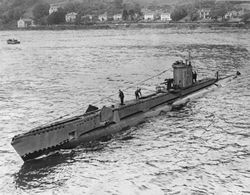
 In 1945, a cat and mouse game between the German submarine U-864 and the British attack submarine the HMS Venturer became such a story that ended in a bold move by the British submarine commander. The story actually started in 1944 when U-864 was dispatched from Germany under the command of Korvettenkapitän Ralf-Reimar Wolfram with an important mission to accomplish. It was headed to Japan with a payload of parts and supplies to help Japan in their war with the United States. They were carrying fighter parts as well as sixty-five tons of mercury to be used in bomb detonators.
Right off the bat, U-864 had problems sustaining damage to its hull that forced Commander Wolfram to divert it to Norway for repairs. While the submarine was being repaired, British bombers further damaged it, which caused even more delays. These delays worked to the advantage of the British as it gave them time to intercept and decode transmissions about the mission of U-864. This is where HMS Venturer entered the picture as it was sent out with the mission of destroying the lethal payload and the German submarine as well.
 Under the command of Lieutenant James Launders, the Venturer had some real advantages given to it during the encounter. U-864 was making more engine noise than it should have been due to the repairs. When the Venturer entered the waters around Norway, Lieutenant Saundars made the first of two bold decisions ordering that the submarine’s sonar be turned off to avoid detection. In the vast waters of the Atlantic, this meant that Lieutenant Saundars would be depending only on periscopes to spot his pray.
The cat and mouse game was on. The excessive noise being made by U-864 played right into the plans of the commander of the Venturer. He was able to hone in on that sound and finally find U-864 by periscope and set out in pursuit intent on fighting her at the surface of the water. Chasing U-864 for three hours, it became more and more evident that the Germans knew they were being hunted. They started using a zigzag pattern to make targeting the submarine impossible or at least very difficult.
Here is where Launders made his boldest decision to use a three-dimensional tracking method that had never been used in a combat situation before. He and his navigators employed this method to calculate the precise firing positions that would be successful and destroying U-864. When the time was right, the commands of “Fire, Fire, Fire, Fire” came quickly as four torpedoes were dispatched 17.5 seconds apart using the calculated positions that they anticipated U-864 to follow.
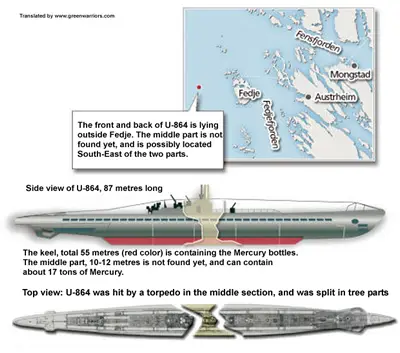
Commander Wolfram heard the three torpedoes hit the water and ordered his submarine to dive. Torpedo one missed. Torpedo two missed. Torpedo three missed. But Launders calculations paid off when torpedo four hit U-864 and ripped the submarine open sending it to the bottom of the ocean with its payload and captain and crew with it.
Why did the U864 not switch to battery to eliminate the noise while returning to Norway base? There should have been an adequate charge to get most if not all of the way back to the base.
Anyone know where you can get a model of the HMS Venturer? Need it as a visual aid in my history classes. Pete